Bhaja Govindam Verse 1
Addressing the Deluded Mind
भज गोविन्दं भज गोविन्दं गोविन्दं भज मूढमते ।
सम्प्राप्ते सन्निहिते काले नहि नहि रक्षति डुकृञ्करणे ॥
bhaja govindam bhaja govindam govindam bhaja mūdhamate |
samprāpte sannihite kāle nahi nahi rakṣati dukṛňkarane ||
- he mūḍhamate: Oh deluded mind!
- govindaṃ bhaja: Worship bhagavan (Govinda)! Worship bhagavan! Worship bhagavan! (Govinda is the one known by the jīvas and known by the Vedas).
- kāle samprāpte sannihite: When the time (of death) has approached well and is very near,
- ḍukṛñkaraṇe: the grammatical rule “ḍukṛñ karaṇe” (representing worldly knowledge and rituals)
- na hi rakṣati: surely will not protect (you).
Summary: Delusion between the means – sādhanam and the end – sādhyam.
Oh foolish mind, worship govinda, who is the ultimate truth taught by the scriptures.
When the time of death approaches, the recitation of grammar rules, worldly actions, and Vedic rituals will certainly not protect you.
Therefore, one must realize this supreme truth, because mere actions cannot grant mokṣa.
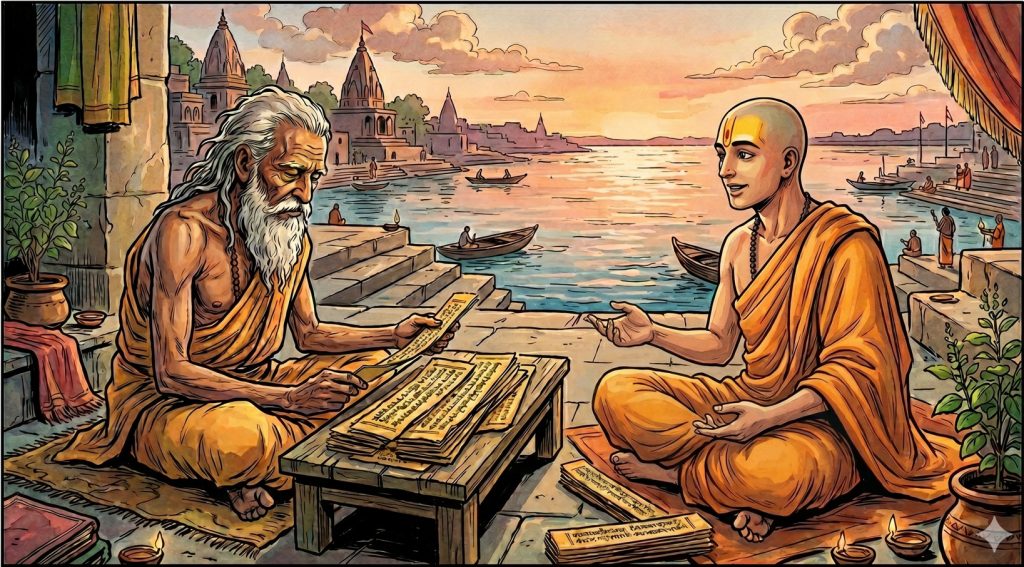
Swamiji explains that Adi Shankaracharya directly addresses the Kashi pandit—and through him, humanity—as mūdhamate. This refers to a person whose intellect is utterly deluded and confused about life’s true priorities, mistaking a temporary tool or means for an ultimate goal.
The Instability of Life
Life’s instability is constantly driven by time (kālatattvam). देहिनोऽस्मिन् यथा देहे कौमारं यौवनं जरा dehino’smin yathā dehe kaumāram yauvanam jarā. The physical body constantly changes from childhood to youth to old age, and all earthly positions are impermanent.
The Ultimate Anchor
Swamiji uses the analogy of taking a bath at the Haridwar ghats where the fast-flowing Ganga river is directed through a narrow canal. If you try to secure yourself by holding onto the sand, rocks, or mossy steps, they will all slip away due to the force of the current. Just as bathers must tightly hold onto fixed iron chains hooked to immovable pegs to avoid being swept away, we must anchor ourselves to something stable in the ever-changing river of life. That stable, stationary anchor is govindah (the eternal īśvara). Swamiji notes that the word has multiple derivations: the protector of the cows (kṛṣṇāvatāra), the protector of the earth from demons, and the protector of the sense organs as the inner essence (antarātmā). While earthly relationships last at most for one lifetime and are temporary, the relationship with bhagavan is permanent and reliable.
Repetition for Emphasis
To emphasize the urgent necessity of seeking bhagavān, Shankaracharya repeats the instruction: bhaja govindam bhaja govindam.
The Urgency of Time
The instruction to seek the Lord is repeated for emphasis because time (yamadharmarāja) operates constantly on every object, meaning our bodies are continually aging and moving closer to the grave. Time does not just arrive at the end of life; between the beginning and end of a single hour, cells die and the body moves closer to the grave. When the final moment arrives (kāle sannihite samprāpte), only bhagavan, who is the conqueror of time and beyond time (kāla kālah), can provide true security. Therefore, we must start practicing this devotion immediately.
The Final Rehearsal (sivashankarashtakam)
अतिभीषण कटुभाषण यमकिङ्कर पटली कृतताडन परिपीडन मरणागम समये । उमायसह मम चेतसि यमशासन निवसन् हर शङ्कर शिव शङ्कर हर मे हर दुरितम् ॥ atibhīṣaņa kațubhāṣaņa yamakińkara pațalī kṛtatādana paripīdana maraņāgama samaye | umāyasaha mama cetasi yamaśāsana nivasan hara śańkara śiva śańkara hara me hara duritam ||
Quoting the śivaśańkarāṣṭakam, Swamiji describes how at the time of death, Yama’s assistants (yamakińkara) arrive with diseases, pain, and frightening conditions—likened today to being in an ICU covered in medical tubes. Shankaracharya prays for Lord Shiva and Goddess Parvati (umā) to enter the stage of his mind and perform their cosmic dances (tāndava and läsyam) so that he can forget his bodily agony. Swamiji emphasizes that to focus on bhagavan during such intense suffering requires lifelong rehearsal starting right now.
Mistaking the Means for the End
The verse explicitly warns that rote learning, such as the grammar root dukrñkarane, will not save or protect you (nahi nahi rakṣati). This does not mean one should stop studying language or science. Rather, language and sciences are a means (sādhanam), and it is a fundamental delusion to convert them into an ultimate end (sādhyam).
The Lesson on Worldly Education
Swamiji recites the verse again to further elaborate on its underlying lesson regarding worldly education.
Material vs. Spiritual Knowledge
Material sciences and worldly education, such as grammar, represent aparā vidyā, while liberating spiritual knowledge is parā vidyā. Material knowledge is an essential stepping stone, but dedicating one’s entire life exclusively to aparā vidyā without ever progressing to parā vidyā is a profound delusion. Swamiji compares this to a person who spends their entire morning and afternoon busy cooking breakfast and lunch, but never actually takes the time to sit down and eat.
The Limbs of the Veda
As the mundaka upaniṣad states, material sciences like grammar, phonetics, and astronomy are limbs of the veda (vedāngāni): शिक्षा कल्पः व्याकरणम् निरुक्तम् छन्दः ज्योतिषम् śikṣā kalpaḥ vyākaraņam niruktam chandah jyotişam. These are meant to be foundational tools designed to help us understand ultimate spiritual truths.