Note: Swamiji makes a reference to maitreyi brahmanam regarding conditional love.
This section explains maiteryi brahmana in more detail.
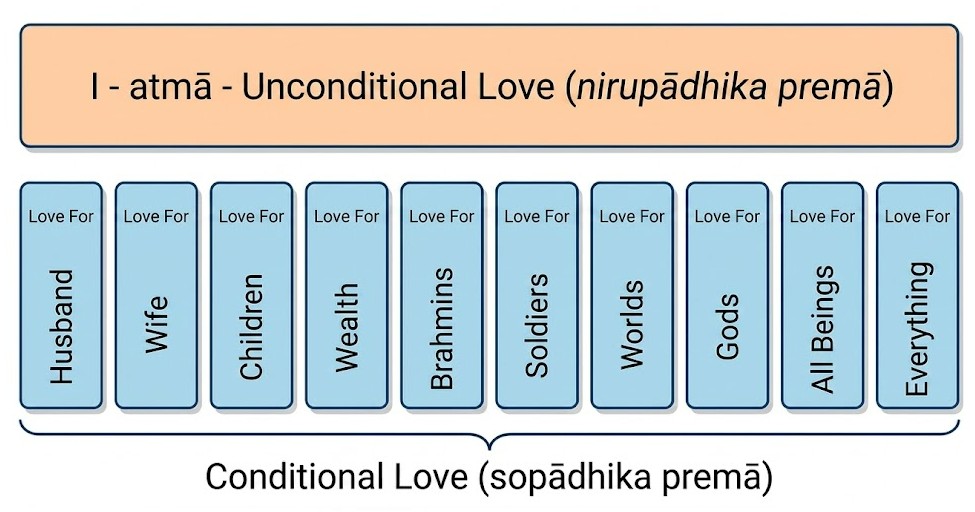
The Secret of Love (ātmā as Love)
In the maitreyī brāhmaṇam section of the bṛhadāraṇyaka upaniṣad, the sage yājñavalkya imparts a profound philosophical truth to his wife maitreyī, which stands as the “secret of love.” Swamiji clearly explains the deep psychological and spiritual truth behind who we truly love and why we love them in this world.
Two Types of Love: Swamiji categorizes love (premā) into two types:
- Unconditional love (nirupādhika premā): The love every individual has for themselves is natural (sahaja premā), universal (sārvatrikī premā), and completely unconditional (nirupādhika premā). Regardless of one’s condition (even if one falls ill or loses their physical beauty), a person never loses their love for themselves.
- Conditional love (sopādhika premā): The love we place on others or external objects is conditional (sopādhika premā). We love them only as long as they bring us happiness; if that happiness is not received, the love is withdrawn.
To convey this truth, yājñavalkya teaches maitreyī by pointing out various worldly relationships and objects through the following mantras:
Mantra 1: Love for the Husband
न वा अरे पत्युः कामाय पतिः प्रियो भवति । आत्मनस्तु कामाय पतिः प्रियो भवति । na vā are patyuḥ kāmāya patiḥ priyo bhavati | ātmanastu kāmāya patiḥ priyo bhavati |
Explanation: A husband is not loved for the sake of the husband; rather, the wife loves the husband for her own sake (for the happiness of her own ātmā). If the husband ceases to give happiness, that love diminishes.
Mantra 2: Love for the Wife
न वा अरे जायायै कामाय जाया प्रिया भवति । आत्मनस्तु कामाय जाया प्रिया भवति । na vā are jāyāyai kāmāya jāyā priyā bhavati | ātmanastu kāmāya jāyā priyā bhavati |
Explanation: A wife is not loved for the sake of the wife; the husband loves the wife for his own sake (for his own happiness).
Mantra 3: Love for the Sons
न वा अरे पुत्राणां कामाय पुत्राः प्रिया भवन्ति । आत्मनस्तु कामाय पुत्राः प्रिया भवन्ति । na vā are putrāṇāṃ kāmāya putrāḥ priyā bhavanti | ātmanastu kāmāya putrāḥ priyā bhavanti |
Explanation: Sons are not loved for the sake of the sons; sons are loved for one’s own sake (for one’s own happiness).
Mantra 4: Love for Wealth
न वा अरे वित्तस्य कामाय वित्तं प्रियं भवति । आत्मनस्तु कामाय वित्तं प्रियं भवति । na vā are vittasya kāmāya vittaṃ priyaṃ bhavati | ātmanastu kāmāya vittaṃ priyaṃ bhavati |
Explanation: Wealth is not loved for the sake of wealth; wealth is loved for one’s own sake.
Mantra 5: Love for the Brahmins
न वा अरे ब्रह्मणः कामाय ब्रह्म प्रियं भवति । आत्मनस्तु कामाय ब्रह्म प्रियं भवति । na vā are brahmaṇaḥ kāmāya brahma priyaṃ bhavati | ātmanastu kāmāya brahma priyaṃ bhavati |
Explanation: Brahmins are not loved for the sake of the brahmins; because they pray for the welfare of the world, we love them for our own sake.
Mantra 6: Love for the Kshatriyas
न वा अरे क्षत्रस्य कामाय क्षत्रं प्रियं भवति । आत्मनस्तु कामाय क्षत्रं प्रियं भवति । na vā are kṣatrasya kāmāya kṣatraṃ priyaṃ bhavati | ātmanastu kāmāya kṣatraṃ priyaṃ bhavati |
Explanation: The ruling kshatriyas are not loved for the sake of the kshatriyas; they are loved for one’s own sake, for the protection they provide us.
Mantra 7:
Love for the Worlds
न वा अरे लोकानां कामाय लोकाः प्रिया भवन्ति । आत्मनस्तु कामाय लोकाः प्रिया भवन्ति । na vā are lokānāṃ kāmāya lokāḥ priyā bhavanti | ātmanastu kāmāya lokāḥ priyā bhavanti |
Explanation: Worlds like heaven are not loved for the sake of the worlds; they are loved for one’s own utility, believing that going to those worlds will bring us peace.
Mantra 8: Love for the Gods
न वा अरे देवानां कामाय देवाः प्रिया भवन्ति । आत्मनस्तु कामाय देवाः प्रिया भवन्ति । na vā are devānāṃ kāmāya devāḥ priyā bhavanti | ātmanastu kāmāya devāḥ priyā bhavanti |
Explanation: The gods are not loved for the sake of the gods; gods are loved for our own sake, either out of fear that they might cause us trouble if not worshipped, or with the expectation of gaining benefits from them.
Mantra 9: Love for All Beings
न वा अरे भूतानां कामाय भूतानि प्रियाणि भवन्ति । आत्मनस्तु कामाय भूतानि प्रियाणि भवन्ति । na vā are bhūtānāṃ kāmāya bhūtāni priyāṇi bhavanti | ātmanastu kāmāya bhūtāni priyāṇi bhavanti |
Explanation: All beings, from the smallest to the largest (trees, animals, etc.), are not loved for the sake of the beings; they are loved for one’s own sake.
Mantra 10: Love for Everything
न वा अरे सर्वस्य कामाय सर्वं प्रियं भवति । आत्मनस्तु कामाय सर्वं प्रियं भवति । na vā are sarvasya kāmāya sarvaṃ priyaṃ bhavati | ātmanastu kāmāya sarvaṃ priyaṃ bhavati |
Explanation: Nothing is loved for the sake of itself; rather, one loves everything for one’s own sake (for one’s own ātmā).
ātmā as the Embodiment of Bliss: According to the scriptures, wherever there is supreme love, there lies actual bliss. Since we love ourselves (ātmā) more than anything else in the world, it is clear that ātmā is the very embodiment of supreme bliss (paramānanda svarūpa).
We search for happiness in anātmā (external objects, relationships). However, in reality, there is no true happiness in anātmā; it is of the nature of sorrow or is merely a false appearance of happiness (sukha ābhāsa). Even the love we have for bhagavan is a form of good selfishness cultivated for our own happiness.
Therefore, yājñavalkya clarifies to maitreyī through this teaching that if one wishes to attain unalloyed supreme bliss, they must stop searching for happiness externally and instead discover their own true nature as ātmā, which is the true embodiment of bliss.