Bhaja Govindam Verse 20
भगवद्गीता किञ्चिदधीता गङ्गाजललवकणिका पीता ।
सकृदपि येन मुरारिसमर्चा क्रियते तस्य यमेन न चर्चा ॥ 20 ॥
bhagavadgītā kiñcidadhītā gaṅgājalalavakaṇikā pītā |
sakṛdapi yena murārisamarcā kriyate tasya yamena na carcā || 20 ||
- yena: by whom; bhagavadgītā: the Bhagavad Gita; kiñcit: a little; adhītā: is studied / chanted; gaṅgā-jala-lava-kaṇikā: a tiny drop of Ganga water; pītā: is drunk; sakṛdapi: even once (or even a little bit); murāri-samarcā: worship of Murari (Lord Vishnu); kriyate: is done; tasya: to him; yamena: with Yama (the lord of death); carcā: dispute / discussion; na: is not (does not happen)
Summary: Three Basic Disciplines
Whoever daily recites even a small portion of the bhagavad gītā, drinks a tiny drop of Ganges water, and sincerely worships bhagavān even once, cultivates profound spiritual purity.
Through this continuous devotion and scriptural study, one receives divine grace, attains true knowledge, and completely overcomes the fear of death.
Consequently, when the end of life approaches, such a devoted person will peacefully depart and will not have to face any conflict or argument with yama.


The Author and the Basic Spiritual Disciplines
- The anonymous disciple: This verse was composed by dṛḍhabhakta, another disciple of ādi śaṅkarācārya whose detailed biography and other works are not known to us. In this verse, he provides essential, foundational spiritual exercises that every seeker should strive to practice.
The First Discipline: Scriptural Study
- The necessity of theory: Before practicing any aspect of religion, one must know the theory behind it. Practicing without knowing the underlying theory leads to wrong practices, much like attempting a sport without a coach to teach the proper grip and technique.
- The essence of all scriptures: Hinduism contains an endless ocean of scriptures (ananta śāstraṃ bahu veditavyam). However, human beings have limited time and face countless obstacles (alpaśca kālo bahavaśca vighnāḥ). Because it is impossible to study everything, the veda and dṛḍhabhakta advise that the complete essence (sāram) of all scriptures is contained within the bhagavad gītā.
- The true meaning of kiñcit: The phrase bhagavad gītā kiñcit adhītā does not mean studying only a small, partial fraction of the text (like stopping after the first chapter). Instead, kiñcit means studying the entire gītā to the extent required for one’s own understanding. Even without knowing the Sanskrit language, one can study the entire gītā using translations and commentaries to grasp the sādhanā. Every Hindu is encouraged to study the whole gītā at least once in their lifetime, which fulfills the essential practice of svādhyāya.
The Second Discipline: Austerity and Mastery Over the Senses
- The symbolism of the Ganges: The instruction gaṅgā jala lavakaṇikā pītā (sipping a droplet of Ganges water) is a symbolic expression. It represents undertaking a pilgrimage (tīrthayātrā), which in turn represents the broader practice of tapas (austerity or deliberate self-denial).
- The practice of tapas: tapas means learning to live without the specific comforts we have grown addicted to. Whether it is fasting during ekādaśī upavāsam or giving up coffee for a week, it is a deliberate self-denial designed to establish complete mastery over our sense organs.
- Overcoming deceptive addictions: A habit is incredibly deceptive; it appears too weak to worry about until we suddenly recognize it is too strong to give up. mokṣa is defined as emotional freedom from all such addictions. To escape bad addictions, one must initially form good addictions (like removing a thorn with another thorn), and eventually transcend even the good ones.
The Third Discipline: Daily Worship of the Lord
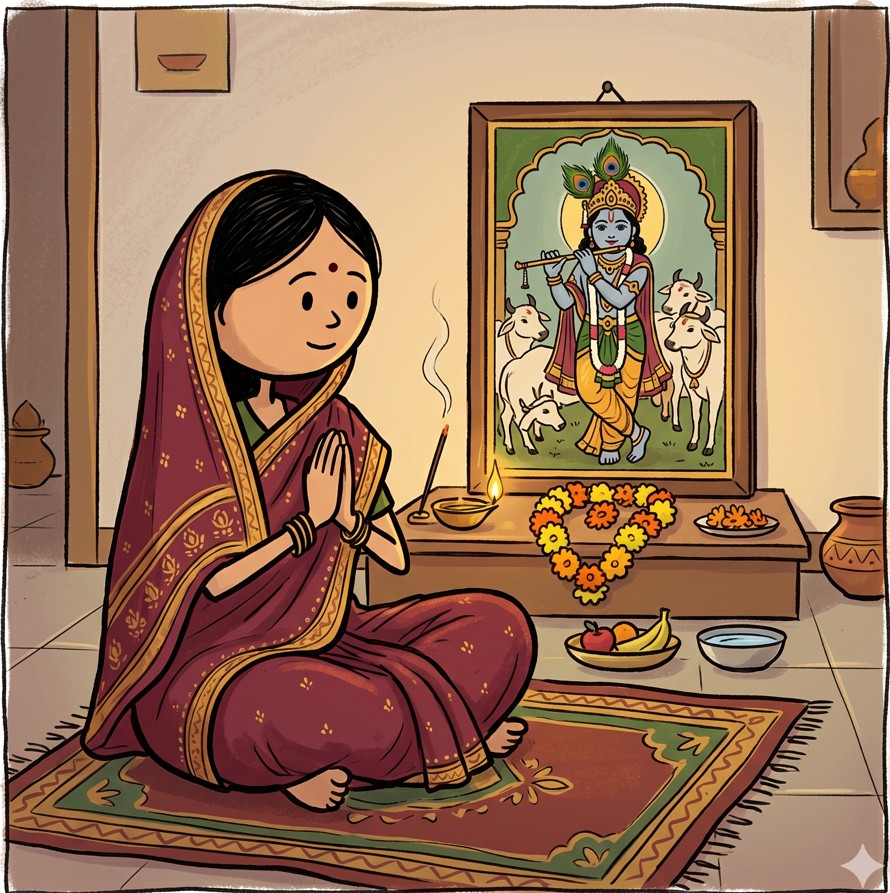
- Converting the house into a temple: The phrase sakṛdapi yena murārisamarcā means worshiping bhagavan (referred to here as murāri or Vishnu) at least once a day. By dedicating a pūjā room and spending just five minutes offering a flower, doing namaskāra, and chanting nāma, a regular house is transformed into a sacred temple.
- Protection from modern materialism: In today’s world, materialism is an overpowering monster displacing spirituality. While we cannot control the outside society, we can protect our homes. Getting up before sunrise, lighting a lamp, and chanting bhagavan‘s nāma creates powerful spiritual vibrations that protect the family from adverse influences and instill strong saṃskāra in children.
The Ultimate Result: Conquering the Lord of Death
- Freedom from affliction: If a person follows these disciplines, kriyate tasya yamena na carcā—meaning yamadharmarāja (the lord of death and time) will not trouble or even discuss that family.
- Physical and mental immunity: On a physical level, scientific studies have statistically proven that religious people possess better physical immunity and health. Thus, regular spiritual practice naturally keeps away diseases, which are themselves a manifestation of yama‘s influence.
- Discovering immortality: Ultimately, leading such a life gradually guides a person to mokṣa. Upon attaining mokṣa, the seeker transcends time (kālatattvam) and discovers immortality, thereby permanently pushing away yama and escaping the prison of mortality.